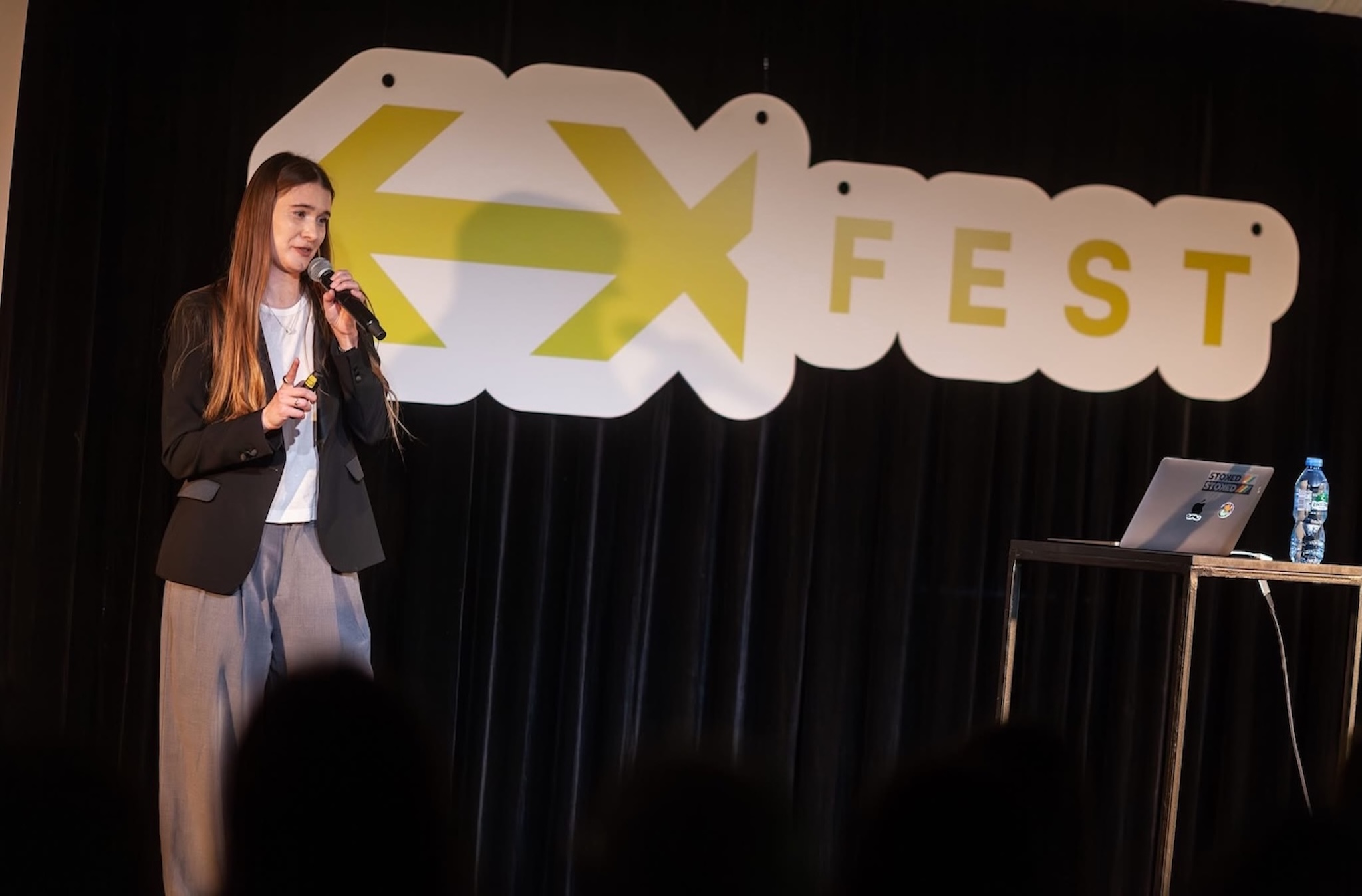


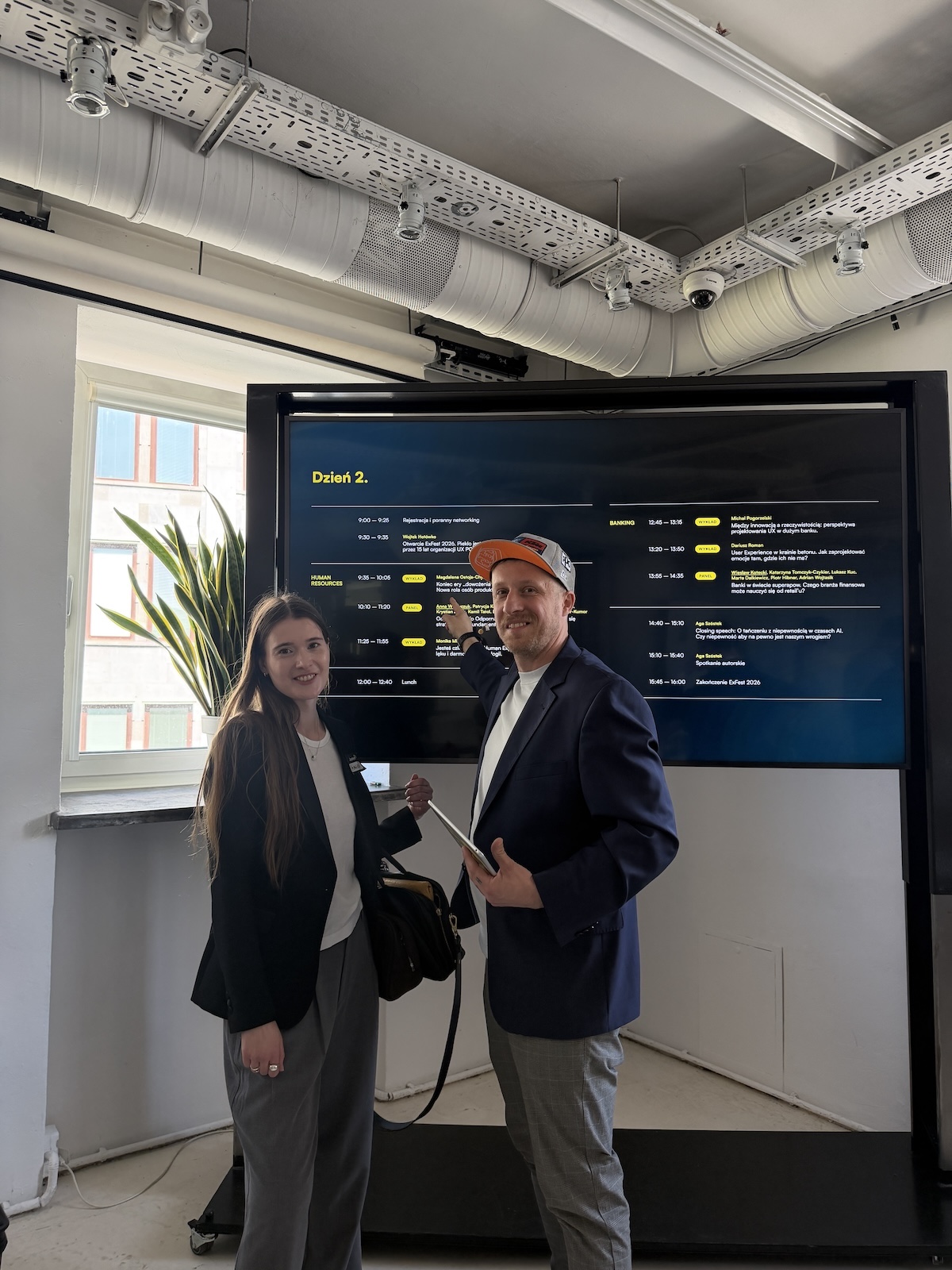
On April 17, 2026, during EXFEST - Experience Festival in Warsaw, Magdalena Ostoja-Chyżyńska, CEO & Founder of UX GIRL, delivered a presentation titled The Era of Enablers: The End of the Delivery Era and the New Role of Product Professionals. Rather than focusing on specific UX methods or design trends, the talk explored a broader transformation that is currently changing the way digital products are built and how product teams operate.
The presentation offered a perspective on how technology has shaped professional roles over the last three decades and why artificial intelligence may be initiating another significant shift in the industry.
From the Era of Webmasters to the Era of Specialists
Magdalena began by taking the audience back to the early years of the internet. During the 1990s and early 2000s, a single webmaster was often responsible for nearly every aspect of building and maintaining a digital product. Design, development, analytics, databases, copywriting and graphics frequently belonged to one role.
As technology evolved and digital products became more sophisticated, organizations responded through specialization. New professions emerged, including UX designers, UI designers, UX writers, frontend and backend developers, testers, product owners and project managers. What was once handled by a single person gradually became distributed across entire teams of specialists.
This evolution brought many benefits. Specialized knowledge enabled companies to build more advanced products, improve quality and create better experiences for users. However, it also introduced new challenges. Teams became larger, processes became more complex and communication between disciplines became increasingly important.
AI as a New Turning Point
According to Magdalena, artificial intelligence represents another major turning point in this story.
For years, the industry moved toward narrower and narrower specializations. Today, AI tools are allowing professionals to cross many of these boundaries once again. Designers can generate interfaces and prototypes faster than ever. Developers can use AI-assisted coding tools. Researchers can process large volumes of information more efficiently. Product teams can analyze data, create reports and explore new ideas with significantly less effort.
This does not mean that expertise is disappearing. Instead, AI acts as a force multiplier that enables individuals to accomplish tasks that previously required multiple specialists or significantly more time. The presentation described AI not as a replacement for human work but as a technology that expands human potential.
What Has AI Actually Changed?
One of the central sections of the presentation focused on four major changes introduced by AI.The first is abundance. AI can generate enormous quantities of content, ideas, designs, code and solutions. For many organizations, the challenge is no longer producing options but selecting the right ones. In a world where almost anyone can create something, the ability to evaluate, prioritize and curate becomes increasingly valuable.
The second change is speed. Tasks that once required days of work can now be completed within hours or even minutes. This acceleration allows teams to spend less time on repetitive execution and more time on strategic thinking.
Third, AI expands capabilities. Professionals are no longer restricted by the traditional boundaries of their role. A designer can better understand technical implementation. A developer can participate more actively in product discussions. A product manager can explore data and research in greater depth. AI makes multidisciplinary work more accessible.
Finally, AI brings teams closer to business. When routine tasks become easier to execute, more attention can be directed toward customer needs, business goals, key metrics and long-term product strategy.
The End of the Delivery Era
A particularly interesting message from the presentation concerned the traditional understanding of productivity in product organizations. For years, many teams were evaluated primarily on their ability to deliver. Success was measured through completed tasks, released features and executed roadmaps. However, when AI reduces the effort required to build, design and analyze, simply delivering outputs becomes less of a competitive advantage.
Instead, organizations increasingly need people who can identify meaningful opportunities, define valuable problems to solve and connect business objectives with user needs. The discussion shifts from “Can we build it?” to “Should we build it?” and “What impact will it create?” This represents a significant change in how product work is understood.
Moving Closer to Business Outcomes
Another important theme of the presentation was the growing relationship between product teams and business strategy. Magdalena highlighted that modern product professionals need to understand not only interfaces and features but also objectives, key results and company priorities. The presentation showed how daily tasks should connect to broader business goals and measurable outcomes rather than existing as isolated activities.
In this context, AI becomes a tool that helps teams move beyond operational work and participate more actively in strategic decision-making. Product, design and technology professionals are expected to understand business problems and contribute directly to solving them.
The Rise of the Enabler
The concept that tied the entire presentation together was the idea of the “Enabler.” An enabler is someone who uses technology, knowledge and collaboration to unlock value for others. Rather than focusing exclusively on one specialization, enablers connect disciplines, facilitate decision-making and help organizations achieve meaningful results.
The future may therefore belong less to narrowly defined specialists and more to professionals capable of combining different perspectives, leveraging AI effectively and translating complexity into business impact.
Final Thoughts
Magdalena Ostoja-Chyżyńska’s presentation offered an optimistic view of the future of product work. While artificial intelligence is undoubtedly changing established ways of working, it is also creating new opportunities for growth and innovation.
The key message was not that specialization is becoming obsolete, but that the role of professionals is evolving. As AI takes over more repetitive and operational activities, people can focus on strategy, creativity, problem-solving and business impact.
The era of simply delivering work may be coming to an end. What emerges in its place is the Era of Enablers — professionals who use technology not only to build products, but to create meaningful value for users, teams and organizations.

.svg)